Author: SUHMAN, Crusher Engineer
Foreword
In the global construction machinery industry, searching for “jaw crusher sizes” is the most common first step in equipment procurement. With diverse market demands, manufacturers produce a wide variety of sizes and specifications. This article, from the perspective of a factory engineer, objectively outlines the logic behind jaw crusher size selection, helping you make informed purchasing decisions.
Industry Status Quo: Why are “Size Parameters” Confusing?
Limitations of PE Series Parameter Tables Most jaw crusher
parameter tables currently on the market are based on the PE series standards from the 1980s and 90s.
These tables typically include the following fields:
Model (PE-600×900)
Feed opening size (mm)
Maximum feed size (mm)
Eccentric shaft speed (rpm)
Processing capacity (t/h)
Motor power (kW)
Dimensions (mm)
Total weight (t)
The problem is that these parameters are mostly theoretical values calculated based on ideal operating conditions (uniform feeding, medium-hardness limestone, standard discharge opening). In actual projects, factors such as material hardness, moisture content, and feed particle size distribution can cause actual capacity to deviate significantly from the parameter tables.
Furthermore, the PE series was originally designed for fixed installation—requiring the pouring of concrete foundations and the construction of steel structure platforms. With today’s trend towards mobility, more and more projects require tracked or wheeled mobile crushing plants, which have completely different overall size, transportation methods, and deployment logic.
The concept of “size” in a moving jaw crusher is more complex.
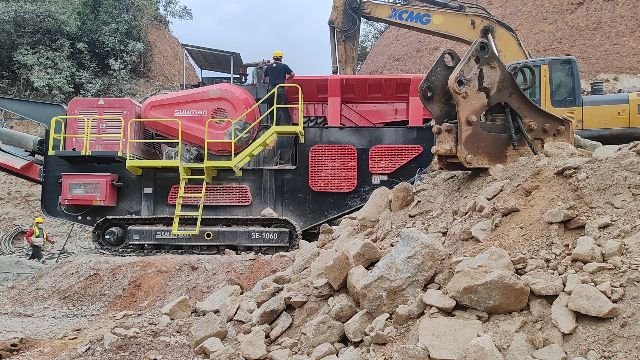
Taking Suheman’s SE series mobile jaw crusher as an example, the “size” of a machine cannot be judged solely by its feed opening:
| Consideration dimensions | Traditional fixed jaw fracture | Mobile jaw crusher |
| Feed port size | Decisive indicators | Important, but not the only one |
| Transport width | Not important (bulk shipment) | Key limiting factors |
| Working weight | Relatively fixed | Impact on ground bearing capacity requirements |
| Deployment time | Several weeks (for laying the foundation) | No installation required, simple setup in 2-4 hours |
| Mobility | none | Depending on track/tire configuration |
This means that a “size selection guide” that only discusses the feed port is incomplete for buyers of mobile devices.
How to Scientifically Interpret the Dimensional Parameters of a Jaw Crusher?
Feed Opening: Understanding “Nominal Size” and “Effective Size”
Jaw crusher models are usually named after their feed opening size, such as PE-600×900, which indicates a feed opening width of 600mm and a length of 900mm.
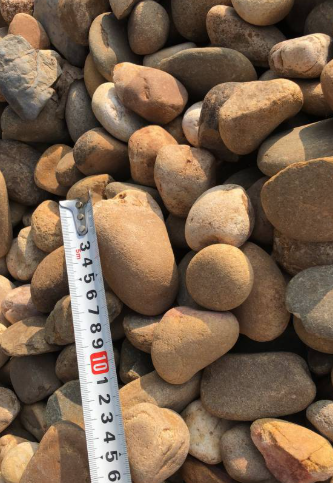
Engineering Rule of thumb: Maximum permissible feed size ≈ 0.8 times the feed opening width. That is, the effective feed limit for a PE-600×900 is approximately 480mm. Exceeding this ratio can easily cause material bridging at the feed opening, leading to jamming and machine downtime.
Real-world deviation: Some manufacturers’ molds have negative tolerances, meaning the actual feed opening may only be 580mm or even smaller. As a factory, we use laser CNC cutting during production to ensure tolerances are controlled within ±2mm—this is not marketing rhetoric, but a fundamental guarantee for the long-term stable operation of the equipment.


Discharge Port (CSS): The Hub Connecting “Input” and “Output”
The Closed Side Setting (CSS) is a key parameter determining the finished product particle size range and production capacity.
Smaller CSS (40-60mm) → Finer finished product, but lower production capacity and faster jaw plate wear.
Larger CSS (100-150mm) → Coarser finished product, higher production capacity, and slower wear.
Selection Decision Logic:
If you need multiple sizes of gravel (0-5mm, 5-10mm, 10-20mm), you should choose a model that supports hydraulic CSS adjustment. The Suheman SE series comes standard with a hydraulic adjustment system, allowing a single person to complete adjustments in minutes.
If manual adjustment using shims is used, each change of discharge port requires half a day of downtime to disassemble the equipment, resulting in extremely high labor costs.
Processing Capacity: The “Conversion Factor” for Parameter Table Values
Almost all jaw breaker parameter tables specify a capacity range, such as “50-180 t/h“. Where is this number derived?
Frankly, it’s an ideal value. In actual projects, the following correction factors need to be considered:
| Influencing factors | Correction direction | approximate range |
| Material hardness (granite vs. limestone) | Downward correction | -15% ~ -25% |
| The material has a high moisture content (>5%). | Downward correction | -10% ~ -20% |
| Uneven feeding | Downward correction | -10% ~ -15% |
| Reduce the size of the discharge port | Downward correction | -20% ~ -40% |
Practical advice: When selecting a model, treat the “upper limit capacity” in the parameter table as your target value, not your bottom line. For example, if you need a stable output of 200 TPH, you should choose a model whose parameter table indicates 250-280 TPH.
SUHMAN SE Series: Mobile Jaw Crusher Size Comparison Reference
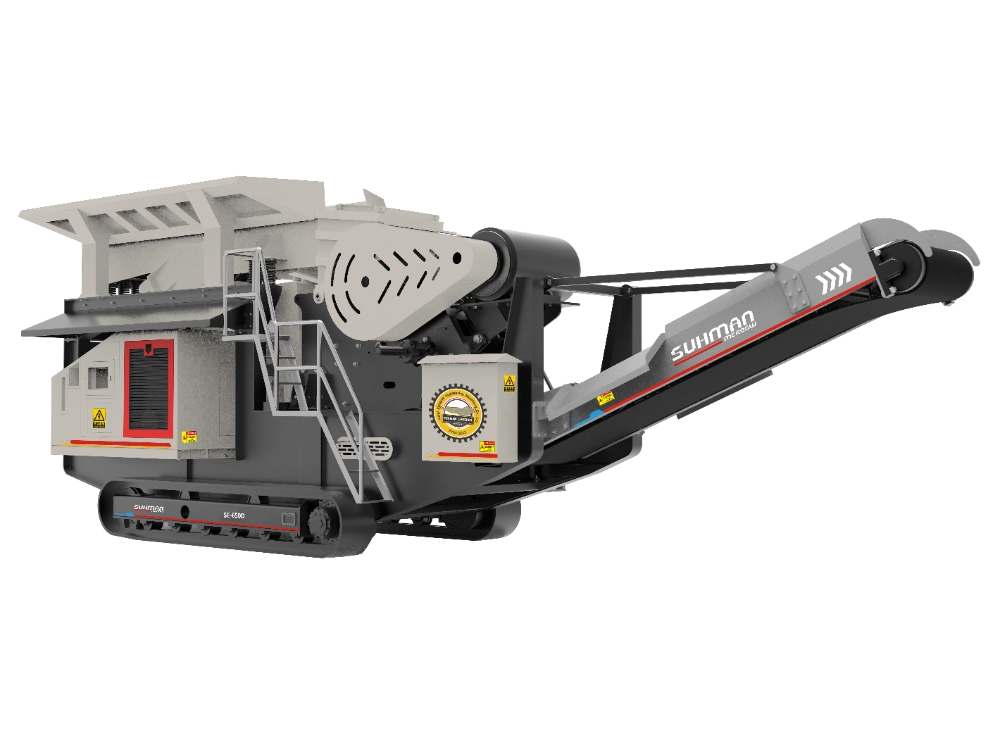
Below are the key dimensional parameters of the three main mobile jaw crushers currently in mass production at the Suheman factory (based on actual production data):
| model | Feed port (mm) | Maximum feed rate (mm) | Typical capacity (TPH) | Shipping dimensions (L×W×H mm) | Total weight (t) |
| SE-650D | 500×700 | 500 | 50–130 | 10000×2700×3500 | 30 |
| SE-1060 | 1060×750 | 700 | 200–250 | 15500×3400×3900 | 42.5 |
| SE-1160 | 1160×800 | 700 | 230–280 | 15500×3700×3900 | 50 |


Additional Information:
SE-650D: Featuring a compact design, suitable for urban demolition, on-site construction waste processing, and small quarries. Its dual-power configuration (diesel engine + electric motor) allows it to operate normally in areas with insufficient power grid coverage.
SE-1060: A deep-cavity V-shaped crushing chamber design offers approximately 15-20% higher capacity compared to competing models of the same size. Suitable for medium-sized quarries and infrastructure projects.
SE-1160: Weighing only 48 tons, its 1160×800mm extra-large feed opening allows it to handle even 700mm granite with ease. Its 135kW 8-pole motor features a low-speed, high-torque design, extending jaw plate life by 20-30% compared to 4-pole high-speed models.
Furthermore, Suheman also produces the TZ6510 dual-core jaw crusher, uniquely featuring two synchronously moving jaws, achieving a crushing ratio as high as 15:1 (traditional jaw crushers typically have a 3-5:1 ratio). This means that a 500mm feed can be directly crushed to a 40mm finished product, with one machine completing both coarse and medium crushing tasks.
Common Misconceptions in Equipment Selection
Misconception 1: Focusing Only on Feed Port, Ignoring Transportation Limitations
Many buyers only focus on crushing capacity when selecting equipment, neglecting transportation dimensions. In China, the legal width for road transport is 3 meters. If the equipment width exceeds 3 meters, an oversized transport permit is required, significantly increasing costs and time.
Sughman strictly controls transportation dimensions during the design phase. For example, the TZ6510 is only 3583mm long, allowing it to be transported in a standard 40-foot high cube container, greatly reducing international shipping costs.
Misconception 2: Ignoring Material Characteristics Differences
Even with “granite,” the rock hardness, joint development, and weathering degree can vary greatly from ore deposit to ore deposit. A customer from South Africa reported that a PE-750×1060 recommended by a trading company only achieved 60% of the specifications listed when processing local granite.
As a factory, we usually inquire about the Mohs hardness, SiO₂ content, and typical block size distribution of the material before providing a quote to offer more accurate selection advice.
Misconception 3: Underestimating the Importance of Maintenance Access
Jaw plates are core wear parts of jaw crushers and require regular replacement. If the machine’s structural design is flawed, replacing jaw plates may require dismantling half the equipment, taking 8-12 hours.
The Suheman SE series’ hydraulically folding side plate design allows maintenance personnel to directly open the side plates to access the crushing chamber. A two-person team can complete jaw plate replacement in approximately 4 hours—this directly impacts the equipment’s maintainability and annual uptime.
Why are more and more projects choosing direct sourcing from factories?
This discussion doesn’t focus on price advantages (although they certainly exist), but rather on an engineering and technical perspective:
Traceability of Technical Solutions
When you communicate directly with the factory, every technical parameter can be traced back to the design drawings and Bill of Materials (BOM). Motor brand, bearing model, steel plate thickness—these are all verifiable. Trading companies, on the other hand, typically only provide a generic parameter list.
Boundaries of Customization Capabilities
Not all projects are suitable for the same standard model. For example: Some regions use 440V instead of 380V grid voltage, requiring a redesign of the electrical system; regions with strict environmental regulations require engines to meet specific emission standards; dealers need OEM production to establish a local brand. These needs can only be met by factories with independent R&D capabilities. Suheman currently supports voltage customization, appearance customization, configuration upgrades, and OEM production.
Timeliness of After-Sales Response
Speed of response to equipment failures is crucial. Trading companies typically need to contact the factory first, wait for a response, and then relay the information to the customer—a long information chain prone to distortion and delays.
Under the factory-direct sales model, our after-sales engineers can provide on-site operation guidance directly via video link, or go to the site when necessary. Meanwhile, we maintain a stock of thousands of vulnerable parts at our Hefei headquarters, and standard parts can be shipped out on the same day.
If you are currently selecting a product,
we do not recommend making a decision based solely on one article.
The most reliable approach is to provide detailed pictures or videos of your raw materials, and our engineers will help you determine the most suitable equipment for your needs free of charge.
Clearly define your project parameters: including maximum feed size, target capacity, finished product particle size requirements, and site conditions.
Get multiple options for comparison: we will provide detailed technical parameters and quotations for 2-3 alternative options for your comparison and decision.
Website: https://ahsuhman.com/
Whatsapp/Phone: +86 13856971828
البريد الإلكتروني: ahsuhman@163.com