By Xandra Huang, Technical Sales Engineer — 8+ years in mobile crushing solutions
Limestone is the most widely used raw material in the construction industry, accounting for over 70% of global aggregate production.
But here’s a problem many buyers face: choosing the wrong crushing equipment can waste $50,000 to $100,000 per year in unnecessary wear parts, energy, and downtime.
If you’re planning a limestone crushing project, you likely have three questions:
- Which type of crusher is best for limestone?
- Should I choose a mobile or fixed plant?
- What is the realistic return on investment (ROI)?
This guide will answer these questions with technical data, cost analysis, and real-world case studies — so you can make an informed decision.
Limestone Properties: Why They Dictate Your Equipment Choice
Before selecting any equipment, you need to understand the material you’re crushing.

Limestone is a sedimentary rock with the following characteristics:
- Mohs hardness: 3-4 (soft rock)
- Compressive strength: 80-150 MPa
- Silica content: Usually low (< 5%)
- Moisture & clay content: Varies by deposit
Why this matters: Because limestone is a soft rock with low abrasiveness, it does not require the heavy compression crushing used for hard rocks like granite or river pebble. Instead, impact crushing is the most efficient and cost-effective method.
According to a 2023 study by the International Journal of Mining Science and Technology, impact crushers achieve 30-40% higher efficiency than cone crushers when processing soft to medium-hard rocks like limestone.
The Standard Limestone Crushing Process
A typical limestone crushing plant follows this process flow:
Step 1: Feeding & Primary Crushing Raw limestone (up to 800mm) is fed into a jaw crusher via a vibrating feeder. The jaw crusher reduces the material to 80-150mm.
Step 2: Secondary Crushing The 80-150mm material enters an impact crusher. This is the core crushing stage for limestone. The impact crusher reduces the material to 10-50mm, producing a cubical shape ideal for concrete and asphalt.
Step 3: Screening & Classification A vibrating screen separates the crushed material into different sizes: 0-5mm, 5-10mm, 10-20mm, and 20-35mm. Oversize material is returned to the impact crusher for re-crushing.
Optional Step 4: Sand Making If you need manufactured sand (0-5mm) for concrete or mortar, a VSI sand making machine can be added after the secondary crusher.
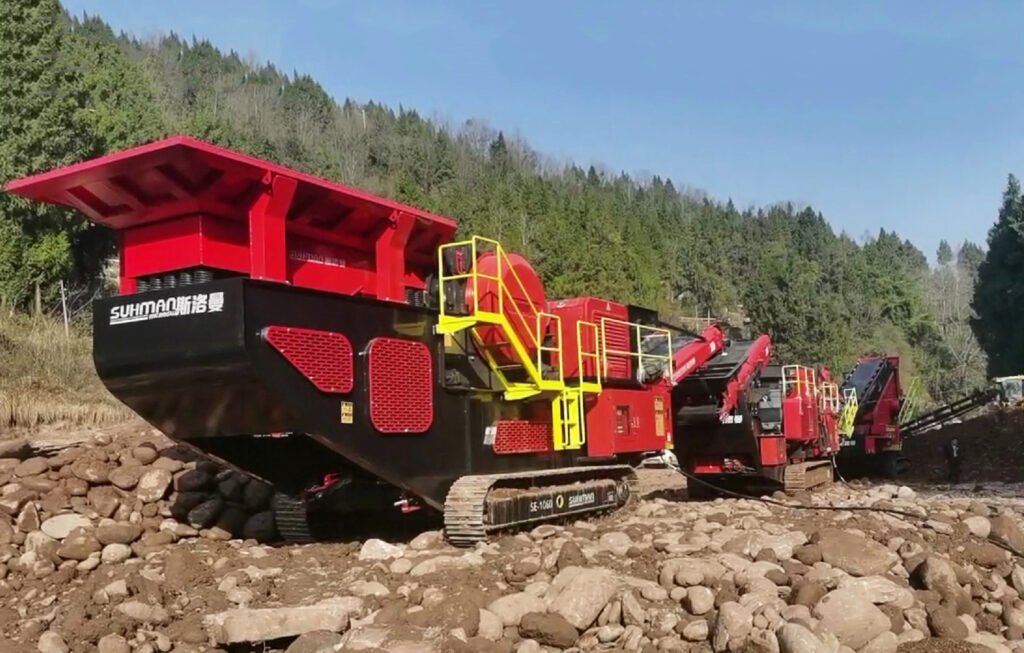
For a complete mobile setup, the SE-1060 Mobile Jaw Crusher handles primary crushing, while the SF-380D Mobile Impact Crusher handles secondary crushing. The SS-7018 Mobile Inclined Screener completes the line with final classification.
Impact Crusher vs. Cone Crusher for Limestone
This is the most common equipment question we receive. The short answer: use an impact crusher for limestone.
Here’s the detailed comparison:
| Factor | Impact Crusher | Cone Crusher |
| Crushing Principle | Impact (hammer blows) | Compression (layer crushing) |
| Best For | Soft to medium-hard rock (limestone, dolomite, gypsum) | Hard & abrasive rock (granite, basalt, river pebble) |
| Wear Parts Cost | $0.50-$1.00 per ton (blow bars last 800-1,200 hours) | $2.00-$4.00 per ton (liners wear faster on soft rock due to over-crushing) |
| Product Shape | Excellent cubical shape (flakiness < 10%) | Good, but more needle-like particles |
| Initial Investment | Lower | Higher (more complex hydraulic system) |
| Maintenance | Simple (replace blow bars easily) | Complex (requires specialized tools & training) |
Conclusion: For limestone, an impact crusher is not just cheaper — it produces better-shaped aggregate and costs less to operate. Cone crushers are overkill for soft rock and will increase your per-ton cost by 40-60%.
For high-capacity limestone projects, the SF-580D Mobile Impact Crusher Plus is a popular choice, offering 250-350 tph with a robust rotor design.
Mobile vs. Fixed Plant: 5 Questions to Decide
Once you’ve decided on the equipment type, the next decision is mobility. Use this quick tool to determine which setup fits your project:
| Question | Choose Mobil | Choose Fixed |
| 1. How long is your project? | Under 5 years | Over 10 years |
| 2. How many sites will you operate? | 2 or more sites | 1 site only |
| 3. What is your site terrain? | Mountainous, riverbank, or narrow | Flat and open |
| 4. What capacity do you need? | Under 400 tph | Over 500 tph |
| 5. How fast do you need to start? | Under 1 week | Over 1 month is acceptable |


How to interpret your answers:
- 3+ answers favor mobile → A mobile crushing plant is right for you
- 3+ answers favor fixed → A fixed plant may be better
- 2 each → Consider a modular plant as a middle-ground solution
For modular setups, the SE-J1060 Modular Jaw Crusher offers a balance between mobility and cost, requiring no concrete foundation but needing crane assistance for relocation.
Cost & ROI Analysis: Why Limestone Crushing is Profitable
Limestone crushing is one of the most profitable aggregate operations due to low operating costs and high market demand.
Limestone vs. Hard Rock: Cost Comparison
| Cost Item | Limestone (Soft Rock) | Granite / River Pebble (Hard Rock) |
| Crusher Type | Impact Crusher | Cone Crusher |
| Wear Parts Cost | $0.50-$1.00 / ton | $3.00-$6.00 / ton |
| Energy Consumption | $1.00-$2.00 / ton | $3.00-$5.00 / ton |
| Maintenance Downtime | 2-4 hours / month | 8-12 hours / month |
| Total Operating Cost | $3.00-$5.00 / ton | $8.00-$14.00 / ton |
| Typical Selling Price | $8.00-$15.00 / ton | $15.00-$25.00 / ton |
| Gross Margin | 40-60% | 30-50% |
| Payback Period | 3-6 months | 6-12 months |
Key Insight: While limestone aggregate sells for less than granite aggregate, the operating cost is 60-70% lower. This means limestone projects often have a faster ROI and lower financial risk.
For projects requiring both crushing and screening in a single unit, the SF-580D-S Crushing & Screening Integrated Machine reduces equipment count and setup time, further lowering initial investment.
Real Customer Case Studies
Case A: India Limestone Aggregate Project (2024)
Project Background Located in Rajasthan, this project processed limestone with a maximum feed size of 500mm. The target was 250 tph producing 10-20mm and 20-35mm aggregate for road construction.
Equipment Configuration
- SE-1060 Mobile Jaw Crusher for primary crushing
- SF-380D Mobile Impact Crusher for secondary crushing
- SS-7018 Mobile Inclined Screener for final screening
Results
- Time from delivery to production: 2 days
- Actual capacity: 260 tph
- Wear parts cost: $0.60 / ton
- Payback period: 4 months
The customer’s feedback: “The mobile setup allowed us to move between three different quarry sites in the first year. The impact crusher produced excellent cubical aggregate that met Indian road construction standards.”
Case B: Mexico Limestone Sand Making Project (2023)
Project Background Located in Sonora, this project processed limestone with a maximum feed size of 400mm. The target was 200 tph producing 0-5mm manufactured sand and 5-10mm aggregate for a concrete batching plant.
Equipment Configuration
- SE-1060 Mobile Jaw Crusher for primary crushing
- SF-380D Mobile Impact Crusher for secondary crushing
- SC-85D Mobile VSI Crusher for sand making
- SS-7018 Mobile Inclined Screener for final screening
Results
- Time from delivery to production: 3 days
- Actual capacity: 210 tph
- Sand fineness modulus: 2.7 (Grade II, ASTM C33 compliant)
- Payback period: 5 months
The customer’s feedback: “Adding the VSI sand maker increased our revenue by 30% because manufactured sand sells at a premium in this region. The mobile line paid for itself in 5 months.”
5 Common Mistakes in Limestone Crushing
Based on our experience with 120+ limestone projects worldwide, here are the most common (and costly) mistakes:
Mistake #1: Using a Cone Crusher for Limestone
As explained above, cone crushers are designed for hard rock. Using one for limestone increases wear parts cost by 40-60% and produces more needle-like particles.
Mistake #2: Ignoring Moisture & Clay Content
If your limestone has high moisture (> 10%) or clay content, standard impact crushers can clog. In these cases, use an impact crusher with a pre-screen or a hammer crusher with a grate bar.
Mistake #3: Mismatched Capacity Between Stages
A common error is pairing a large jaw crusher with a small impact crusher. This creates a bottleneck. Ensure the secondary crusher has equal or greater capacity than the primary crusher.
Mistake #4: Using Steel Screen Mesh for Wet Material
Standard steel screen panels blind quickly with wet limestone. Use polyurethane or multi-slope screens for better screening efficiency.
Mistake #5: Not Planning for Future Expansion
Start with a modular or mobile crushing line. If you later decide to add sand making or a tertiary crusher, you can do so without rebuilding the entire plant. See the European Aggregate Production Association’s guide to modular crushing plants.
Why Limestone is a Smart Investment
According to USGS Limestone & Crushed Rock Statistics, global limestone production has grown by 5% annually over the past decade, driven by infrastructure development and cement production.
The Portland Cement Association reports that limestone is used in over 90% of concrete mixes, ensuring consistent demand. The Construction Aggregate Producers Association notes that limestone aggregate is preferred for its workability and lower density compared to granite.
For limestone crushing projects, the combination of low operating costs, fast ROI, and consistent market demand makes it one of the safest investments in the aggregate industry.
Get Your Free Crushing Solution
Not sure which equipment configuration fits your limestone project? Tell us about your material and we’ll analyze it for free:
Please provide:
- Limestone compressive strength (MPa)
- Maximum feed size (mm)
- Target capacity (tph)
- Desired product sizes (0-5mm / 5-10mm / 10-20mm, etc.)
- Moisture & clay content (%)
We’ll recommend the most suitable equipment configuration and provide a detailed ROI analysis.
Get Your Free Crushing Solution →
About the author: Xandra Huang is a Technical Sales Engineer at Anhui SUHMAN Engineering Machinery Co., Ltd., with 8+ years of experience in mobile crushing solutions. She has personally contributed to 120+ crushing project designs serving clients across Southeast Asia, Africa, South America, and the Middle East.
This article was reviewed by the SUHMAN Technical Engineering Team and is based on field data from 120+ crushing projects. All performance figures are representative values from actual customer installations; individual results may vary based on material characteristics and operating conditions.