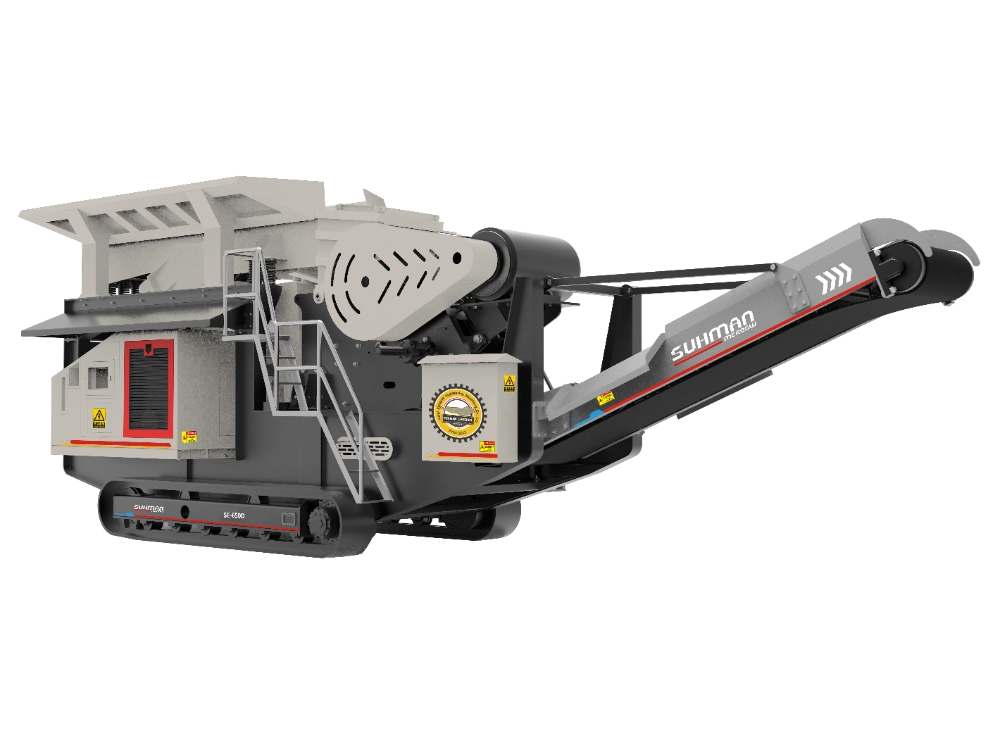
What Is a Jaw Crusher?
A jaw crusher is a primary crushing equipment used in mining, quarrying, and construction sites to break down large rocks into smaller, manageable sizes. At SUHMAN, we specialize in crawler-type mobile jaw crushers that combine portability with industrial-grade performance.
Unlike fixed crushing plants, our mobile jaw crushers can be transported directly to the job site—whether it’s a steep mountainside quarry, an urban construction zone, or a remote mining operation.
Quick Answer: A jaw crusher works by compressing rock between two jaws—one stationary and one moving. The moving jaw applies pressure to break the material, which then exits through the bottom opening at your desired size.

How Does a Jaw Crusher Work?
Understanding the crushing process helps you choose the right equipment for your operation. Here’s the step-by-step workflow of a SUHMAN mobile jaw crusher:
1. Power System Activation
Our crushers feature a diesel-electric hybrid power system. You can operate the machine using:
- Onboard diesel generator (for remote sites without grid power)
- External electrical connection (for cost-effective stationary operation)
2. Material Feeding
- Load material into the vibrating feeder hopper using an excavator or wheel loader
- The vibrating feeder controls the flow rate, preventing overload and choking
- Optional pre-screening removes fine material before it enters the crusher chamber
3. Crushing Chamber Operation
- Material enters between the fixed jaw and moving jaw (die jaws)
- The moving jaw applies compressive force, breaking rocks against the stationary jaw
- Adjustable closed-side setting (CSS) controls output size (typically 0-180mm)
4. Metal Removal
- An overband magnet (iron remover) automatically extracts rebar, steel, and tramp metal
- Protects downstream equipment and ensures cleaner final product
5. Discharge & Transport
- Crushed material exits via the main discharge conveyor
- Conveyor height and angle are adjustable for optimal stockpiling or direct loading
- The entire unit moves on crawler tracks, controlled via wireless remote
Key Components of a Mobile Jaw Crusher
| Component | Function | SUHMAN Advantage |
|---|---|---|
| Power System | Controls all electrical functions | Hybrid diesel-electric, fuel-efficient |
| Control Box | Remote operation of walk, conveyor, crusher | Wireless remote with emergency stop |
| Iron Remover | Extracts metal contaminants | Overband magnet, self-cleaning |
| Discharge Conveyor | Transports crushed material | Foldable, height-adjustable |
| Crawler Undercarriage | Machine mobility | Independent track control, 30° gradient capability |
| Vibrating Feeder | Regulates material flow | Variable speed, pre-screen option |
| Feed Hopper | Material storage | Large capacity, reinforced walls |
| Jaw Crusher | Primary crushing | Hardened manganese steel jaws, adjustable CSS |
Applications & Materials
Where Jaw Crushers Are Used
SUHMAN jaw crushers are deployed across multiple industries:
- Mining Operations: Primary crushing of hard rock ores (gold, copper, iron)
- Quarry & Aggregate Production: Breaking limestone, granite, basalt for construction
- Construction Waste Recycling: Processing demolished concrete, asphalt, bricks
- Infrastructure Projects: Road building, bridge construction, railway ballast
- Demolition Sites: On-site crushing to reduce transport costs
Materials We Crush
| Material Type | Examples | Compressive Strength |
|---|---|---|
| Hard Rock | Granite, Basalt, Andesite, River Gravel | Up to 320 MPa |
| Medium Rock | Limestone, Sandstone, Dolomite | 150-250 MPa |
| Recycled Material | Concrete, Asphalt, Demolition Waste | Variable |
| Industrial Waste | Slag, Mining Tailings | Variable |
Industry Standard: Jaw crushers are designed for materials with compressive strength not exceeding 320 MPa. Exceeding this limit can cause premature wear or mechanical failure.
Why Choose SUHMAN Mobile Jaw Crushers?
1. Military-Grade Quality Standards
Manufactured at our 18,000 m² facility in Hefei, Anhui (China’s military industrial zone), every SUHMAN crusher undergoes rigorous quality testing.
2. Proven Performance in Harsh Conditions
- SE-1060 Mobile Jaw Crusher: 200-250 TPH capacity, 700mm max feed
- SE-1160 Mobile Jaw Crusher Plus: 230-280 TPH, enhanced for high-volume operations
- SE-650D Mini Mobile Jaw Crusher: 50-130 TPH, ideal for confined spaces
3. Complete After-Sales Support
- 2-year warranty on all major components
- Free spare parts kit included with every shipment
- On-site installation guidance and operator training
- Dedicated customer service team (response within 2 hours)
4. Flexible Configuration Options
- Choose between diesel-only, electric-only, or hybrid power
- Custom discharge conveyor lengths and heights
- Optional pre-screen or scalping feeder
- Multiple jaw plate profiles for different materials
Jaw Crusher for Sale: What to Consider Before Buying
When evaluating jaw crushers for your operation, ask these questions:
✅ Capacity Requirements
- What’s your target tons per hour (TPH)?
- What’s your maximum feed size?
- What output size do you need?
✅ Mobility Needs
- Will the crusher stay in one location or move frequently?
- Do you need crawler tracks or a wheeled chassis?
- What’s the terrain like (slope, ground conditions)?
✅ Power Availability
- Is grid electricity available on-site?
- Do you need an onboard generator?
- What are your fuel cost constraints?
✅ Budget & ROI
- What’s your total budget (including transport, installation)?
- What’s your expected payback period?
- Are you looking for new or refurbished equipment?
SUHMAN Policy: MOQ = 1 unit. We work with individual contractors and large enterprises alike. Production time: 25-35 days. Payment via T/T or negotiable terms.
Frequently Asked Questions (FAQ)
Q: How do I adjust the jaw crusher gap (CSS)?
A: The closed-side setting is adjusted using hydraulic toggle tension or mechanical shim plates. SUHMAN crushers feature hydraulic adjustment for quick changes without manual labor. Typical range: 0-180mm.
Q: What’s the difference between a jaw crusher and an impact crusher?
A: Jaw crushers use compression (squeezing) for primary crushing of hard rock. Impact crushers use impact force (hammers) for secondary crushing of softer materials or recycling applications. For hard rock mining, start with a jaw crusher.
Q: Can a jaw crusher process wet or sticky material?
A: It’s not recommended. Wet, clay-rich material can cause choking in the crushing chamber. For such materials, consider adding a pre-screen or using a scalping feeder to remove fines.
Q: How long do jaw crusher wear parts last?
A: Jaw plates typically last 3-6 months under normal operation with abrasive materials like granite. With less abrasive materials like limestone, expect 6-12 months. SUHMAN provides free wear parts guidance based on your material.
Q: Do you offer jaw crusher installation and training?
A: Yes. We provide video-guided installation, remote commissioning, and optional on-site training. All operators receive a comprehensive manual and safety checklist.
Ready to Discuss Your Project?
Whether you’re setting up a new quarry, expanding your recycling operation, or replacing aging equipment, SUHMAN’s engineering team can help you select the right jaw crusher configuration.
Contact Us:
- 📞 Phone/WhatsApp: +86 13856971828
- Email: ahsuhman@163.com
- 🏭 Factory Visit: Tangkou Road 43, Feixi Economic Development Zone, Hefei, Anhui, China
No Pressure Consultation: Tell us about your material, capacity needs, and site conditions. We’ll recommend the optimal configuration—whether it’s a SUHMAN mobile jaw crusher or a complete crushing and screening plant.
About SUHMAN: Anhui SUHMAN Engineering Machinery Co., Ltd. is a leading manufacturer of crawler-type mobile crushing and screening equipment. With over 15 years of industry experience and military-grade quality standards, we serve clients in 60+ countries across mining, construction, and recycling sectors.