Read time: ~12 minutes · Last updated: May 1, 2026
If you run a quarry, mine, or construction waste recycling plant, you’ve likely faced this frustrating scenario: your crusher is working at full capacity, burning fuel, and wearing out parts—yet your overall plant throughput hasn’t increased. Why? Because a significant portion of your feed material doesn’t need crushing at all.
Sending pre-sized fines directly into a crusher is like driving a truck with the parking brake on. You’re wasting energy, accelerating wear, and clogging your circuit with material that could have been bypassed.
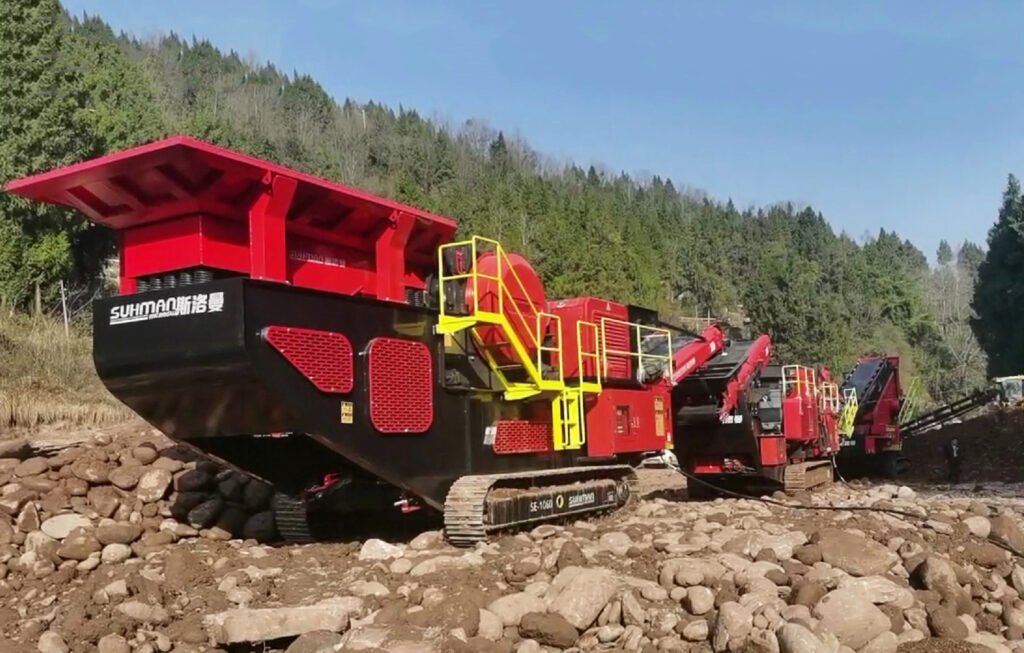
This is exactly why SUHMAN engineers every mobile crusher and screener with a Tail Belt (Bypass Conveyor). It’s not just an accessory. It’s a profit lever.
In this guide, we’ll break down exactly what the tail belt does, how it saves you money, and why it’s the single most underrated component in mobile crushing circuits.
What Exactly Is the “Tail Belt” (Bypass Conveyor)?
In SUHMAN’s factory terminology, the tail belt refers to the conveyor system that intercepts undersize or pre-screened material before it enters the crushing chamber and diverts it directly to the main discharge conveyor.
In the broader industry, this is known as a bypass conveyor, undersize conveyor, or pre-screen bypass. Regardless of the name, the function is the same:
- Material enters the feed hopper or pre-screen.
- Fines and correctly sized material fall through the grating or screen deck.
- The tail belt catches this undersize fraction and transports it straight to the tail discharge.
- Only oversize material proceeds into the crusher for size reduction.
The result? Your crusher only processes what actually needs crushing. The tail belt handles the rest.
5 Ways the Tail Belt Directly Increases Your Profit
1. Frees Up Crusher Capacity → Higher Overall Throughput
A crusher’s chamber volume is fixed. If 30–40% of your feed is already smaller than your desired output size, that space is being wasted. The tail belt removes those fines before they ever touch the crusher.
What this means: Your crusher can dedicate 100% of its energy to breaking oversize material. In real-world operations, adding a bypass tail belt typically increases overall plant throughput by 25–40% without upgrading to a larger crusher.
2. Cuts Energy Consumption by 15–25%
Crushing rock is one of the most energy-intensive processes in aggregate production. Every ton of material that passes through a jaw, cone, or impact crusher consumes significant diesel or electricity.
By bypassing fines, you eliminate unnecessary crushing cycles. Less material in the chamber = less friction, less impact, less power draw.
Real-world impact: Plants using SUHMAN’s tail belt configuration report fuel/electricity savings of 15–25% per ton, directly improving your operating margin.
3. Extends Wear Part Life → Lower Maintenance Cost
Wear parts (jaw plates, cone liners, impact hammers, blow bars) don’t just wear from breaking rock. They wear from friction, abrasion, and constant material flow. When fines constantly recirculate through the chamber, they accelerate liner erosion and increase replacement frequency.
The tail belt drastically reduces the volume of material passing through the crushing zone. Fewer tons processed = slower wear rate.
Industry data: Bypass configurations typically extend wear part life by 30–50%, reducing replacement costs and minimizing unplanned downtime.
4. Prevents Over-Crushing → Better Product Gradation
When fines are forced through a crusher repeatedly, they break down into dust and needle-shaped particles. This ruins your product gradation, increases re-processing needs, and can cause you to fail customer specifications.
The tail belt ensures that only material requiring size reduction enters the crusher. The bypassed fines remain intact, preserving their natural shape and size distribution.
Result: Cleaner final product, less dust generation, higher compliance with construction specs (ASTM/EN standards), and fewer customer complaints.
5. Reduces Chamber Blockages → Higher Uptime
Wet, sticky, or clay-heavy materials are notorious for causing chamber packing and blockages. When fines and moisture accumulate in the crusher, the machine chokes, operators must shut down, and clearing takes 20–60 minutes.
By removing fines before they enter the chamber, the tail belt reduces the material density inside the crusher. This keeps the crushing zone open, improves material flow, and drastically lowers the risk of packing.
Operational benefit: Fewer stoppages, safer clearing procedures, and more consistent production hours per shift.
Real-World ROI: The Math Behind the Bypass
Let’s look at a concrete scenario. You’re processing 1,000 tons/day of limestone with a natural fines content of 35% (material already <50mm).
Without Tail Belt (Traditional Setup)
- All 1,000 tons pass through the crusher.
- Crusher runs at 85% chamber utilization (15% wasted on fines).
- Fuel consumption: ~22 L/hour
- Wear part replacement: Every 600 hours
- Monthly operating cost: ¥195,000
With SUHMAN Tail Belt Configuration
- 350 tons (fines) bypass the crusher via tail belt.
- Only 650 tons enter the crusher → chamber utilization jumps to 98%.
- Fuel consumption: ~17 L/hour (23% reduction)
- Wear part replacement: Every 900 hours (50% longer life)
- Monthly operating cost: ¥142,000
The Difference
- Monthly savings: ¥53,000
- Annual savings: ¥636,000
- Additional revenue: Higher-quality product commands +¥8–12/ton → ~¥96,000–144,000/year
- Total annual benefit:¥732,000–780,000
The tail belt configuration typically pays for itself in 3–4 months. After that, it’s pure margin improvement.
How SUHMAN Engineers the Tail Belt for Maximum Efficiency
Not all bypass conveyors are created equal. SUHMAN’s tail belt isn’t an afterthought—it’s a core component of our circuit design philosophy.
1. Optimized Angle & Height Adjustment
The tail belt is hydraulically adjustable in both angle and discharge height. This allows you to:
- Match the feed elevation of your pre-screen or hopper
- Align perfectly with the main discharge conveyor or next-stage equipment
- Adapt to different site layouts without structural modifications
2. Anti-Wear Lining & Reinforced Structure
Since the tail belt handles continuous material flow (sometimes abrasive or sharp), we line the chute and belt edges with AR400 wear plate and rubber skirting. The frame uses Q345B high-strength steel with full-penetration welds, built at our military-grade facility.
3. Smart Drive & Load Matching
The tail belt uses a hydraulic direct drive with smart load matching. If feed rate drops, the belt automatically slows down, saving energy and reducing belt wear. If material surges, it ramps up instantly to prevent spillage or backup.
4. Seamless Integration with Pre-Screeners
In SUHMAN’s complete circuits, the tail belt is factory-calibrated to work with our scalpers (like the SZ-450D) and crushers. The bypass flow is mathematically modeled to ensure zero bottlenecks, even at peak throughput.
5. Quick-Access Maintenance Design
Belt tracking, tensioning, and roller inspection are designed for one-person, 10-minute maintenance. No scaffolding, no dismantling. Just open the access panel, adjust, and resume production.
Which SUHMAN Machines Feature the Tail Belt?
The tail belt is standard or optional across our mobile crushing and screening lineup:
- SE-1060 Mobile Jaw Crusher – Optional bypass conveyor for pre-screened fines
- SE-1160 Mobile Jaw Crusher Plus – Integrated tail belt for high-capacity circuits
- SE-650D Mobile Jaw Crusher Mini – Compact bypass option for space-constrained sites
- SY-HP300 Mobile Cone Crusher – Bypass-ready for secondary crushing circuits
- SY-HP400 Mobile Cone Crusher Plus – High-volume tail belt configuration
- SF-580D Mobile Impact Crusher Plus – Optimized bypass for construction waste recycling
- SS-7018 Mobile Inclined Screener – Features undersize tail belt for final product diversion

Every machine can be configured with electric, hybrid, or diesel-hydraulic drive options, ensuring the tail belt operates efficiently regardless of your site’s power availability.
Frequently Asked Questions
Q: Can I add a tail belt to my existing crusher?
A: In most cases, yes. SUHMAN offers retrofit kits that integrate with existing hopper and conveyor setups. Our engineering team will assess your current circuit and design a custom bypass solution.
Q: Does the tail belt work with wet or sticky material?
A: Yes. We offer optional belt scrapers, rubber skirting, and anti-blinding chute liners specifically for high-moisture or clay-heavy feed. The bypass actually improves wet material handling by reducing chamber packing.
Q: How much does a tail belt configuration cost?
A: It varies by model and circuit design. However, based on our ROI calculations, the payback period is typically 3–4 months through fuel savings, reduced wear, and increased throughput. We provide a customized cost-benefit analysis with every quote.
Q: Does the tail belt require special maintenance?
A: Minimal. It uses the same drive and tracking system as our main conveyors. Weekly belt tension checks and monthly roller inspections are sufficient. Access panels are designed for quick, safe maintenance.
Q: Can I run the tail belt independently of the crusher?
A: Yes. The tail belt has its own hydraulic/electric drive and can operate in bypass-only mode (screening without crushing) or in tandem with the crusher. This gives you maximum flexibility for changing site conditions.
Get Your Free Circuit Design with Tail Belt Optimization
We don’t do generic quotes. Every recommendation is based on YOUR material, YOUR throughput, YOUR product specs, and YOUR site constraints.
Three Steps:
Step 1: Tell Us About Your Operation (5 minutes)
- What material are you processing?
- What’s your current throughput and crusher model?
- What percentage of fines is in your feed?
- Do you need pre-screening, bypass, or both?
Step 2: Get Your Custom Circuit Design (within 24 hours)
- Tailored crushing/screening circuit diagram
- Tail belt placement and capacity calculation
- Equipment configuration (single machine or complete circuit)
- ROI projection specific to your operation
Step 3: Decide (no pressure, no deadline)
Contact Us
| Channel | Details |
| Phone / WhatsApp / WeChat | +86 138 5697 1828 |
| ahsuhman@163.com | |
| Website | ahsuhman.com |
| Factory Address | No. 43 Tangkou Road, Feixi Economic Development Zone, Hefei, Anhui, China |
Response within 2 hours. Circuit design within 24 hours. No pressure. Just honest engineering advice.