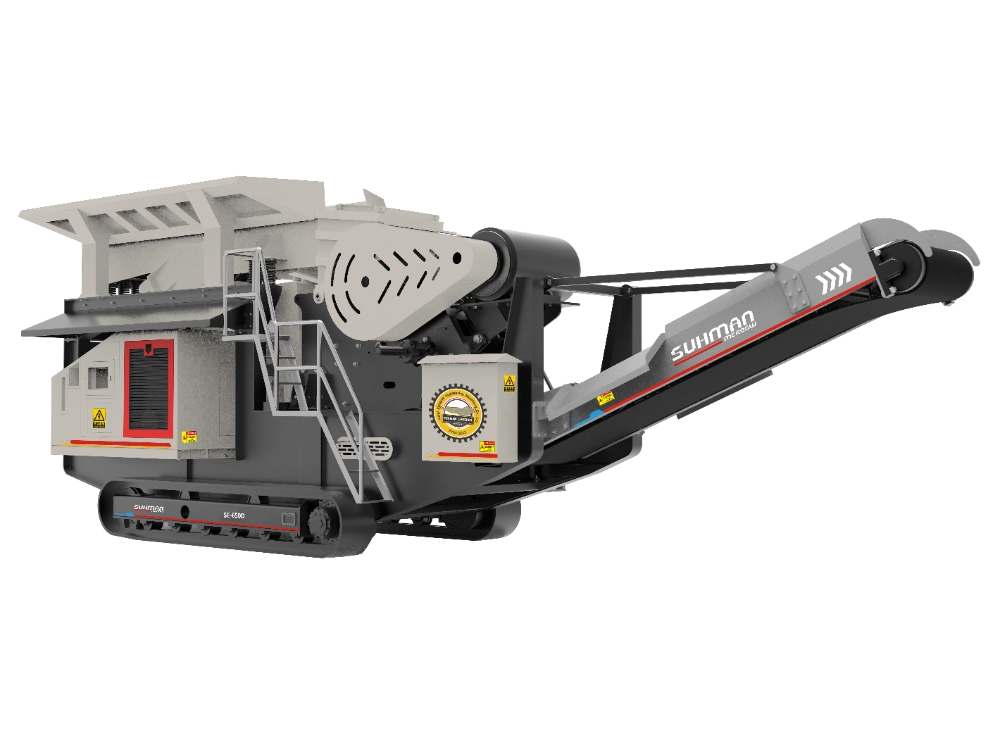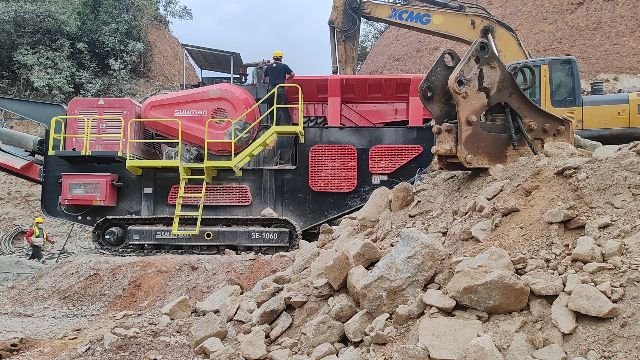
With the expansion of global infrastructure construction, the demand for sand and gravel aggregates from builders is increasing. Jaw crushers, used for primary crushing of sand and gravel aggregates, have consistently held a leading position in recent years. Therefore, whoever masters efficient jaw crusher technology can achieve higher output. Today, we share the world’s first double-moving jaw drum-type compression crusher, recently developed by the SUHMAN team, or simply the dual-core jaw crusher. We will analyze this product below.

Working Description
The dual-core jaw crusher adopts a dual-moving jaw, one moving upwards and the other downwards, arranged in a symmetrical “V” shape.
Most jaw crushers on the market today are compound pendulum jaw crushers. The biggest drawback of this type of jaw crusher is that the crushing work on the material decreases as it moves towards the discharge port, and there is almost no possibility of crushing it near the discharge port.
Crushing work originates from the distance of displacement in the direction of force. The physical formula “W=F*L” states that work equals force multiplied by distance. This jaw crusher structurally solves the problem of insufficient crushing distance at the discharge end. The inverted moving jaw provides a complete crushing stroke at the discharge end, thus achieving an ultra-high crushing ratio. Common compound pendulum jaw crushers have a crushing ratio of 3-5 times, while core jaw crushers can reach a maximum crushing ratio of 15 times, enabling a single machine to complete the process from raw material to aggregate ( directly crushing 500mm raw material to 40mm can achieve a capacity of nearly 100 tons per hour).
Working Principle
Two almost identical moving jaws are arranged in a rotationally symmetrical “V” shape (the jaw plates of the two moving jaws are identical and interchangeable). When the raw material enters the jaw crusher inlet, the upright moving jaw provides maximum crushing stroke and crushing force through an eccentric shaft. After the raw material is gradually crushed, it falls towards the discharge port. The inverted moving jaw at the discharge end also provides maximum crushing stroke and crushing force through an eccentric shaft, ensuring that the raw material receives complete crushing work throughout the entire crushing process, achieving an ultra-high crushing ratio. Two rotationally symmetrical moving jaws are connected by a belt to transmit power synchronously. A 90-degree rotation of the eccentric shaft causes both jaws to move simultaneously to either side of the center line of the “V”-shaped cavity. A further 180-degree rotation moves both jaws back to the center line of the “V”-shaped cavity, crushing the raw material. A final 90-degree eccentric rotation returns the jaws to the starting point, completing one crushing cycle.
Main Technical Parameters
| Feed Inlet | 650×1000mm | Crusher Weight | 12t |
| Discharge Inlet | 65-185mm | Motor | 132kw, 8 motors |
| Dimensions (L×W×H) | 3583×1964×2536mm | Eccentric Shaft Speed | 300r/t |
| Capacity | 80-300TPH |


Summary
Compared to mainstream jaw crushers on the market, the dual-core jaw crusher can crush materials to smaller sizes without reducing capacity, even when faced with the same raw materials. This greatly improves the working efficiency of the jaw crusher. So what is the price range for such a high-efficiency jaw crusher? You can contact the SUHMAN team to get a quote and a crushing and screening solution suitable for you, saving costs while working efficiently.
More on-site work videos can also be viewed on the SUHMAN team’s social media.