Mining operations rarely happen on flat ground. Open-pit mines follow the ore body, not the topography. Quarry faces are cut into hillsides. Road construction projects source aggregate from mountain-side borrow pits. In these environments, a mobile crusher doesn’t just sit on level concrete — it operates on slopes where the machine tilts, the tracks fight for grip, and the operator’s perspective is constantly distorted.
Operating a crawler mobile crusher on a slope is fundamentally different from operating on flat ground. Everything changes — visibility, traction, hydraulic behavior, and most importantly, operator safety.
This article explains what happens when a mobile crusher operates on a slope, why cabin-based operation becomes a liability in these conditions, and how wireless remote travel control gives operators the visibility, control, and safety margin they need.
About the Authors
This article was written by the SUHMAN Engineering Team, based in Hefei, Anhui Province, China. Our team has commissioned and supported mobile crushers in mining and quarrying operations across varied terrain — from flat aggregate yards in Southeast Asia to steep-sided quarry faces in South America and mountain-side borrow pits in Central Asia. All operational recommendations in this article are based on field observations from our commissioning engineers and documented customer feedback.
For technical questions about slope operation, contact our engineering team at ahsuhman@163.com or call +86 13856971828.

Part 1: Where Mobile Crushers Operate on Slopes
Mining and quarrying operations regularly require mobile crushers to work on inclined ground. The three most common scenarios:
Open-Pit Mining Faces Open-pit mines are excavated in benches that follow the ore body. The mining face — where the excavator loads material into the crusher — has a natural slope that matches the pit design. These slopes typically range from 10° to 20°, depending on the rock type and pit geometry. The mobile crusher is positioned on or near the mining face to minimize the distance the excavator needs to reach.
Quarry Bench Mining Quarries extract stone in horizontal benches cut into hillsides. Each bench has a working platform, but the platform itself is often on a slight slope (5°-15°) to allow water drainage. The mobile crusher operates on this bench, receiving blasted stone from the face above and producing aggregate that is loaded onto trucks below.
Mountain-Side Infrastructure Stone Supply Road construction, bridge building, and dam projects in mountainous regions often source aggregate from borrow pits located on hillsides. These sites may have slopes of 10°-18°, with ground conditions that vary from compacted soil to loose blasted rock. The mobile crusher needs to operate on these slopes while processing material for the construction project below.
In all three scenarios, the mobile crusher is not on flat, prepared ground. It’s on a slope, and the slope creates a set of challenges that don’t exist on level ground.
Part 2: What a Slope Does to a Mobile Crusher
Machine Tilt and Operator Vision Distortion
When a crawler mobile crusher sits on a slope, the entire machine tilts. On a 15° cross-slope (tilted sideways), the machine leans 15° to one side. The operator’s cabin tilts with it.
This tilt has immediate effects on the operator’s ability to see and judge:
- Forward vision through the windshield is no longer level. The horizon appears tilted, making it harder to judge distances and alignment.
- Side windows look more at the ground on the downhill side and more at the sky on the uphill side. The operator loses the ability to see the side of the machine clearly.
- The operator’s sense of level is compromised. What feels straight is actually at an angle. This affects steering inputs and positioning accuracy.
Track Grip Changes and Frequent Adjustments
On a slope, weight shifts from the uphill track to the downhill track. This means:
- The downhill track experiences higher ground pressure, which can cause it to sink into soft ground.
- The uphill track experiences less ground pressure, which can cause it to lose traction and slip on loose or hard surfaces.
The operator has to constantly adjust steering inputs to compensate for the uneven grip. On flat ground, equal power to both tracks means the machine goes straight. On a slope, equal power can cause the machine to drift downhill or the uphill track to spin. The operator must apply more power to the uphill track and less to the downhill track — a continuous adjustment that increases cognitive load and fatigue.
Hydraulic System Pressure Changes
The hydraulic system on a crawler mobile crusher controls track drive, crusher operation, feeder speed, and conveyor functions. On a slope, the hydraulic oil in the tank shifts toward the downhill side. In extreme cases, this can affect pump suction and cause cavitation. Most modern hydraulic systems have baffled tanks to prevent this, but it’s an additional variable that doesn’t exist on flat ground.
More significantly, hydraulic cylinders on the crusher itself (such as the CSS adjustment cylinder on a jaw crusher or the hydraulic release cylinders on a cone crusher) experience different load patterns when the machine is tilted. The cylinder on the downhill side carries more load, which can affect adjustment accuracy over time.
Part 3: The Cabin Problem on Slopes
Operator Dizziness and Fatigue
Sitting on a tilted, vibrating machine for hours is physically demanding. The constant tilt conflicts with the operator’s inner ear balance system, which can cause:
- Mild dizziness or disorientation — the operator feels like the world is tilted, even when they look away from the machine
- Motion sickness — nausea, headaches, reduced concentration
- Accelerated fatigue — the body works harder to maintain balance and focus on a tilted platform
An operator who is dizzy or fatigued is slower to react, more prone to errors, and less aware of developing hazards.
Mirror Angles Distort and Lose Reference Value
The side mirrors on a crusher cabin are calibrated for level operation. When the machine tilts 15° or more, the mirror angles change:
- The downhill mirror now shows mostly the ground immediately beside the track, losing the view of what’s behind and to the side.
- The uphill mirror shows mostly the sky or the side of the machine, losing the view of surrounding equipment and personnel.
The mirrors become unreliable. The operator can no longer trust them to show what’s behind or beside the machine. This eliminates the operator’s ability to see approaching loaders, dump trucks, or ground crew — a significant safety risk on multi-machine sites.
Cannot See Track-Ground Contact
This is the most critical blind spot. From inside a cabin, the operator cannot see either track. They cannot see:
- Whether the downhill track is sinking into soft ground
- Whether the uphill track is slipping on loose rock or hard surface
- Whether there’s a large rock, void, or obstruction under one side of the machine
- Whether the track is maintaining full ground contact or lifting off on one side
The operator has to judge track conditions through feedback through the controls — feeling for slippage, watching for unexpected machine movement, guessing based on sound. This is reactive, not proactive. By the time the operator feels a problem through the controls, the problem is already happening.
Part 4: How Wireless Remote Travel Control Changes Slope Operation
Operator Stands on Level Ground
With wireless remote travel control, the operator doesn’t sit on the tilted machine. They stand on level ground beside it, looking at the machine from the side.
This single change solves the visibility problem:
Clear View of Both Tracks From the side, on level ground, the operator can see exactly where each track is contacting the ground. They can see if the downhill track is sinking. They can see if the uphill track is slipping. They can see if there’s a rock or void under one side. They can adjust the machine’s position in real-time based on what they actually see.
Accurate Distance and Angle Perception Standing on level ground, the operator’s sense of distance and angle is normal. They can judge how close the machine is to the edge of a bench, how far it is from other equipment, and whether the ground ahead is stable — without having to mentally compensate for a tilted perspective.
No Vibration, No Dizziness The operator isn’t on the machine, so they don’t experience the tilt or the vibration. They can operate for a full shift without the dizziness and fatigue that cabin operators experience on slopes.
Can Stand on the Side to Monitor Track Slip and Drift
From a side position on level ground, the operator has an optimal view for monitoring track behavior:
- Track slip detection — the operator can see the uphill track spinning without moving the machine forward, indicating loss of grip
- Track drift monitoring — the operator can see if the machine is drifting downhill despite equal track power, indicating uneven ground conditions
- Ground contact assessment — the operator can see if one track is losing contact with the ground (lifting off over a depression), which reduces stability
This level of visibility is impossible from inside a cabin. The operator can make proactive adjustments — reducing power to a slipping track, changing the machine’s path to avoid soft ground, stopping to assess ground conditions — before a problem becomes an incident.
Quick Emergency Evacuation
If something goes wrong on a slope — a track slips, the machine starts to slide, a rock falls from the face above — the operator with a remote is already in the safest position:
- Standing on level ground
- Away from the machine
- Able to move in any direction
They hit the E-stop on the remote and step back. No climbing down a tilted platform. No struggling with a cabin door. No disorientation from being on a moving, tilted machine.
In contrast, a cabin operator has to recognize the emergency, hit the E-stop, open a door on a tilted platform, climb down 2-3 meters on an incline, and then move to safety. Every step is slower and riskier on a slope.
Part 5: Safety Standards and SUHMAN Slope Capability
Industry Recommendations
Most mobile crusher manufacturers recommend a maximum operating slope of 20°-25°. This recommendation balances the machine’s stability, track grip, and hydraulic system performance against the risks of operating on steeper ground.
Industry standards from major manufacturers including Terex MPS and EvoQuip specify similar maximum slope limits for their tracked mobile crushers. The Occupational Safety and Health Administration (OSHA) also provides guidance on heavy equipment operation on inclined surfaces, emphasizing the need for ground assessment and operator visibility.
SUHMAN Slope Capability
SUHMAN crawler mobile crushers are engineered to handle more demanding slope conditions:
- Maximum operating slope: 20° (consistent with industry standards for crushing operation)
- Maximum climbing/travel slope: 30° (SUHMAN track chassis can handle steeper gradients for travel and repositioning)
The 30° climbing capability is made possible by SUHMAN’s track chassis design (LDZ55-3657 and LDZ60-4037 models), which features:
- Low ground pressure distribution across the full track contact area
- High-torque track drive motors for reliable climbing power
- Reinforced track frame for structural integrity on steep gradients
- Combined with wireless remote travel control, which allows the operator to position the machine on steep slopes from a safe, level vantage point with full visibility of both tracks
For detailed specifications on each model:
- SE-650D Mini Mobile Jaw Crusher
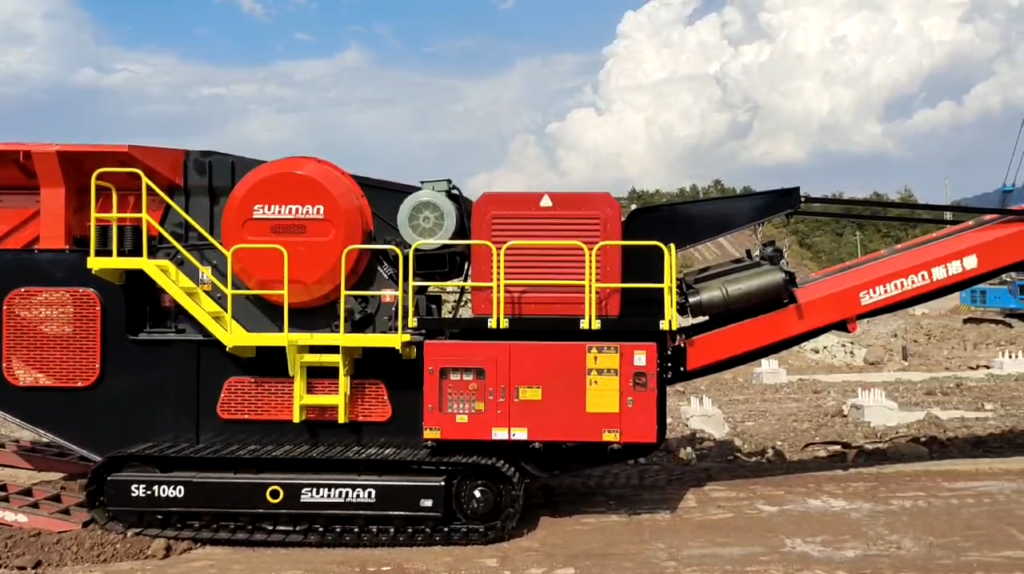
- SE-1060 Mobile Jaw Crusher
- SE-1160 Heavy Duty Mobile Jaw Crusher
- SF-580D-S Crushing & Screening Plant
Pre-Operation Slope Checklist
Before positioning a mobile crusher on a slope:
- Measure the slope angle with an inclinometer — do not estimate by eye
- Test ground bearing capacity at the operating position
- Mark the minimum safe distance from the crusher to any bench edge (minimum 3 meters recommended)
- Plan contour orientation — position the machine parallel to the contour line, not pointing up or down the slope
- Identify emergency exit routes for all personnel
- Check weather conditions — do not operate on slopes during or immediately after heavy rain
Part 6: Real-World Example — Granite Quarry in Southeast Asia
A granite quarry in Vietnam operates on a hillside with slopes ranging from 12° to 18°. The operation uses a SUHMAN SE-1060 mobile jaw crusher as the primary crusher, positioned on the quarry face to receive blasted granite directly from an excavator.
The Challenge: The SE-1060 needs to be repositioned 2-3 times per week as the quarry face advances. Each reposition involves moving the 46-ton machine across a 15° slope on ground that is loose, blasted granite — uneven, with loose rocks and varying bearing capacity.
Previous Method (Cabin Operation): The operator climbed into the cabin, started the engine, waited for hydraulic pressure, and attempted to navigate the machine across the slope. From inside the cabin on the tilted machine:
- The operator could not see the tracks
- Mirrors showed distorted perspectives due to the tilt
- The operator relied on feedback through the controls to judge track grip
- Multiple stops were needed to reassess position
- Average repositioning time: 35-40 minutes
Current Method (Remote Control): The operator stands on level ground to the side of the machine, watching both tracks as the machine moves across the slope. They can see exactly where each track is contacting the ground, can detect slippage immediately, and can adjust the machine’s path in real-time. The result:
- One smooth movement to the target position
- Immediate detection and correction of track slippage
- Average repositioning time: 12-15 minutes
- No incidents of uncontrolled track slippage since switching to remote control
The quarry manager reported: “The remote control changed how we work on the face. Before, the operator was nervous every time we moved the crusher on the slope. Now they stand on level ground, watch the tracks, and move the machine exactly where we need it. It’s faster, and nobody is worried about it anymore.”
Part 7: Summary — The Slope Operation Advantage
| Factor | Cabin Operation on Slopes | Remote Control on Slopes |
| Operator Position | Tilted with machine | Level ground beside machine |
| Track Visibility | Track Visibility | Full view of both tracks |
| Mirror Reliability | Distorted by tilt | Not needed (direct vision) |
| Dizziness/Fatigue | High (tilt + vibration) | None |
| Track Slip Detection | Reactive (through controls) | Proactive (visual) |
| Emergency Response | Slow (exit cabin on tilt) | Instant (already safe) |
| Repositioning Time | 35-40 minutes | 12-15 minutes |
Wireless remote travel control doesn’t just make slope operation more convenient — it makes it fundamentally safer and more efficient. The operator isn’t trapped on a tilted, vibrating machine with distorted mirrors and no track visibility. They’re standing on level ground, seeing everything, controlling everything, and ready to respond to any situation.
How We Verify This Information
All technical specifications in this article are sourced from SUHMAN’s official product documentation. The Vietnam quarry case study is based on documented field observations from our commissioning engineers. Maximum slope angle recommendations are consistent with industry standards published by Terex MPS and EvoQuip, as well as safety guidance from OSHA.
Operate your crusher on any slope, from the safest position on site. SUHMAN crushers handle up to 30° climbing with wireless remote travel control.
Get a SUHMAN Crusher with Wireless Remote Control →
+86 13856971828 | ahsuhman@163.com